Cetinje & Lovcen – Montenegro’s Cultural Heart and Mountain Majesty
Your journey begins with a pickup from your hotel, heading inland toward Podgorica. Shortly after departure, we stop at one of the most beautiful viewpoints overlooking the Budva Riviera. From the lower slopes of Mount Lovćen, you’ll enjoy a sweeping panoramic view of Montenegro’s coastline — a perfect place for photos before continuing deeper into the country.
We travel in a modern, comfortable, air-conditioned luxury van. After about 45 minutes, we arrive in Cetinje, the historical and ceremonial capital of Montenegro.
Cetinje – The Cultural Capital of Montenegro
Located just 32 km from Budva and set at the foot of Mount Lovćen at an altitude of around 670 m, Cetinje is a town of museums, monasteries, embassies, and royal residences. With its authentic architecture and quiet charm, Cetinje is often described as an “open-air museum” and a cultural postcard of Montenegro.
For centuries, Cetinje served as both a battleground and a refuge for Montenegrins. It was also the home of the Petrović-Njegoš dynasty, the ruling family that shaped the identity, independence, and culture of the Montenegrin people.
Biljarda – The Residence of Njegoš
One of the most meaningful cultural sites you can visit in Cetinje is Biljarda, the former residence of Petar II Petrović Njegoš — Montenegro’s prince-bishop, poet, philosopher, and one of the most significant figures in South Slavic literature.
Named after the billiard table Njegoš brought from Vienna, the residence is where he wrote “The Mountain Wreath,”his most famous work. Walking through Biljarda, you gain a vivid sense of the environment in which he lived, ruled, and created his masterpieces.
Next to Biljarda stands a glass pavilion from 1917, housing a large relief model of Montenegro. This impressive installation highlights the rugged, mountainous terrain that made the country nearly unconquerable throughout history.
Other Must-See Landmarks in Cetinje
During your free time, you can take a relaxing walk or enjoy coffee in the city center. We also recommend visiting:
- Cetinje Monastery – Home to priceless relics, including the right hand of St. John the Baptist, believed to be the hand that baptized Jesus.
- Church on Ćipur – Built on the foundations of an older monastery and the burial site of several members of the Petrović dynasty.
- Historic diplomatic quarter – Former embassies from the 19th and early 20th centuries.
The Road to Lovćen – Toward the Njegoš Mausoleum
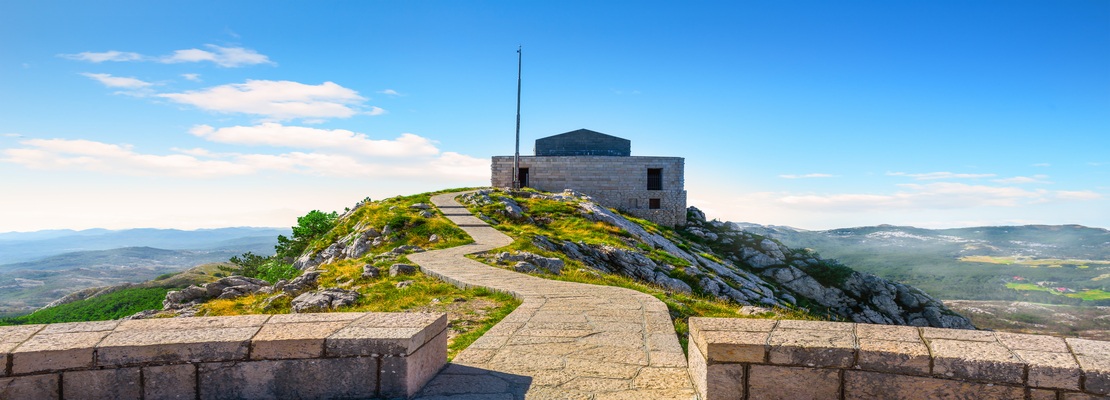
From Cetinje, a scenic mountain road climbs roughly 20 km toward Jezerski vrh, the second-highest peak of Mt. Lovćen. Njegoš personally chose this site as his final resting place — a symbolic place from which he could continue watching over his land.
He deliberately chose the second-highest peak out of humility, believing that the highest, Štirovnik, should remain reserved for future generations. Today, Štirovnik holds a communications tower — a detail that often feels prophetic.
The Njegoš Mausoleum – A Monument Above the Clouds
The original votive chapel built by Njegoš around 1854 suffered severe damage in both World Wars and was eventually replaced in 1974 by the present-day mausoleum, designed by renowned Croatian sculptor Ivan Meštrović.
To reach the mausoleum, you walk through a tunnel and climb 461 steps. At an altitude of 1,660 meters, the viewpoint at the summit rewards you with one of the most breathtaking panoramas in Montenegro:
- The Bay of Kotor
- Lake Skadar
- Montenegro’s northern mountains
- Parts of Albania
- And on exceptionally clear days — even the distant outline of Italy
Inside the mausoleum, two monumental stone caryatids symbolize motherhood and heritage, while a sculptural representation of Njegoš stands in silent tribute. In the crypt below rests his tomb.
A Journey Into Montenegro’s Soul
The combined visit to Cetinje and Lovćen offers a rare insight into Montenegro’s cultural, historical, and spiritual identity. Surrounded by mountain landscapes, centuries-old traditions, and stories of resilience, you’ll gain a deeper appreciation of this proud and rugged Balkan nation.
This tour connects you not just with places, but with Montenegro’s legacy — its rulers, poets, and the enduring spirit of its people.